

MedStock
Medical inventory management system
Overview
Why choose MedStock?
Effective medical inventory management is not just an operational concern — it is a patient safety issue. When supplies run out, expire unnoticed, or are tracked through unreliable manual processes, the consequences reach directly into the clinical environment. MedStock exists to close that gap, giving supply chain teams the visibility and control they need to keep the right supplies available at the right time/
The problem
Medical supplies save lives yet nobody tracks them properly.
Inventory is one of the most critical operational responsibilities in a healthcare environment. Yet the systems most supply chain managers rely on to monitor, replenish, and report on medical supplies are failing them entirely.
78%
of hospital supply chain staff still manually count inventory in some areas
57%
of healthcare workers have experienced a physician lacking required supplies for a procedure
24%
of healthcare providers have seen or heard of an expired product being used on a patient
Problem statement
"Medical supply chain managers understand that inventory accuracy is critical, but lack the real-time visibility, proactive alerts, and structured workflows to manage it effectively — leading to stockouts, compliance risk, and patient safety incidents that compound with every manual process left in place."
User interviews
What four people told me that changed everything.
I conducted 4 in-depth user interviews with medical inventory professionals across hospital, surgical, and supply chain settings. Every design decision in MedStock traces back to a specific finding from these sessions.
Pain point 02
Expiry tracking is entirely manual and error-prone
Participants described checking expiration dates by physically scanning shelves, often using spreadsheets or handwritten logs. Expired items routinely reached clinical areas because no automated system flagged them in advance.
D
"We pulled a box of sutures mid-surgery and they were expired by four months. Nobody caught it because we're checking thousands of items by hand."
Daniel Morrow, 44
Surgical inventory specialist
Pain point 04
Ordering workflows require too many requests
Participants described toggling between three to five separate platforms to complete a single purchase order — EHR systems, vendor portals, internal approval tools, and email. The fragmentation created delays and frequent ordering mistakes.
T
"To reorder one item I'm in four different windows. Half the time I submit the wrong quantity because I lose track of where I am in the process."
Thomas Webb, 52
Material management director
Dominating theme
"Medical inventory professionals are forced to make high-stakes supply decisions using fragmented, outdated information — and the consequences of getting it wrong fall directly on patient care. The system assumes vigilance where it should guarantee visibility."

Principles
Structure, then surface.
Three design principles guided every decision in MedStock — from information architecture through visual design. When choices conflicted, the higher principle won.
Principle 01
Visible, not assumed
Stock levels, expiry dates, and reorder thresholds surface automatically — never buried in a sub-menu. If a clinician has to search for a critical count, the design has already failed.
Usability testing
Testing usability, there were flaws.
Watching real inventory staff use the prototype exposed decisions that looked right in design but broke down under real workflows — shift handovers, multi-department lookups, and urgent reorder scenarios.
78%
avg completion across all 6 of the tasks
What testing validated
The real-time expiry alert banner (100% recognition across all participants) · Color-coded stock status (red/amber/green understood instantly without a legend) · Single-screen reorder flow ("finally, everything in one place") · Department-level inventory view ("I can actually trust this number now") · Bulk expiry export to CSV ("this alone saves me two hours a week")
Key finding 01
Stock status required too many taps to reach
Before
Participants had to navigate through three separate screens to view current stock levels for a single item. Two of five users abandoned the task before reaching the correct screen.
After
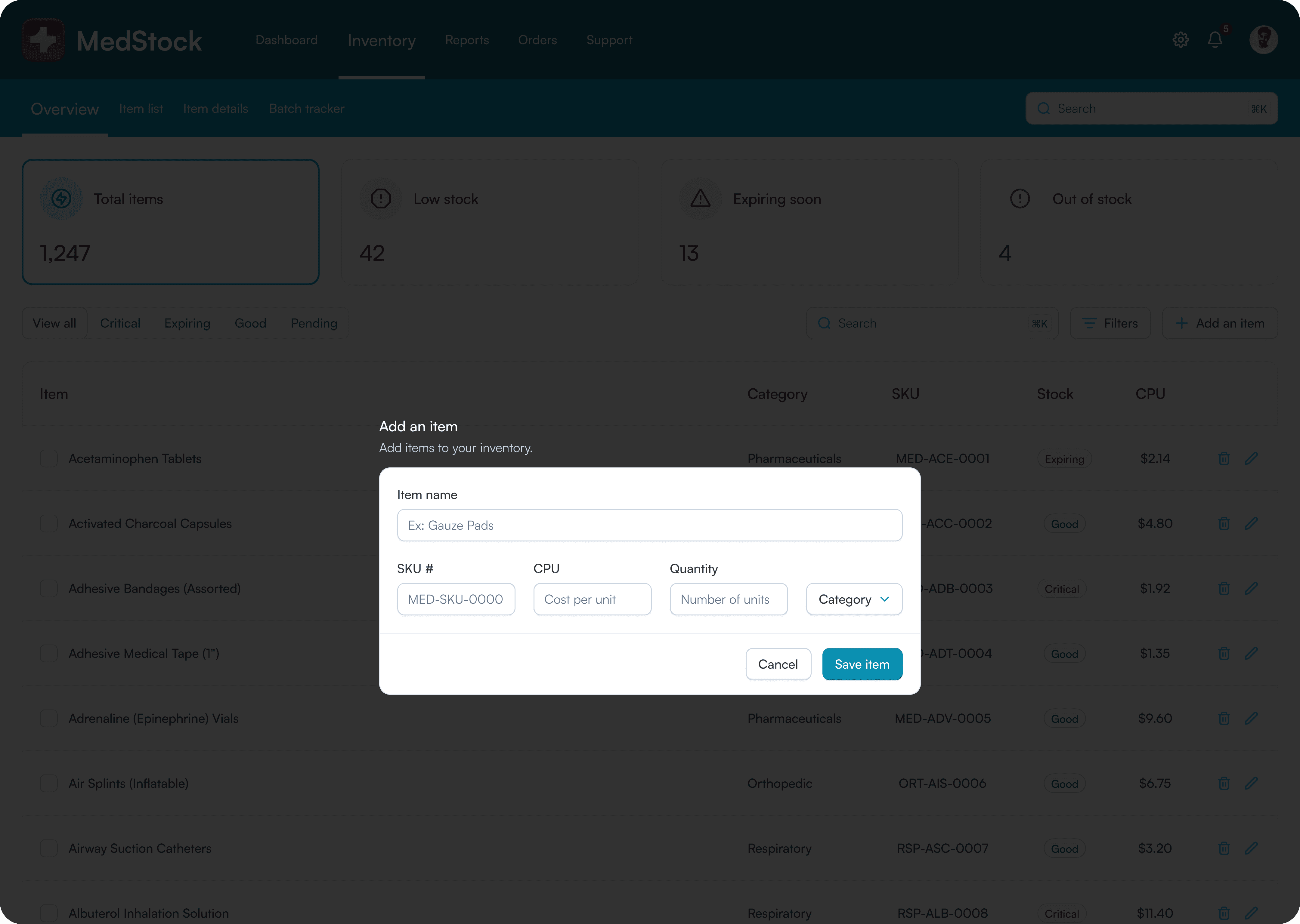
Stock status, quantity on hand, and reorder threshold are now visible on a single dashboard card. Critical items surface automatically at the top, requiring zero navigation.
Key finding 02
Expiry alerts were easy to miss and dismiss
Before
Expiry warnings appeared as a small icon in the corner of an item row, which four of five participants overlooked entirely during the task. One user described it as "just visual noise."
After
Expiry alerts now display as a full-width banner at the top of the relevant department view, with the item name, quantity, and days remaining stated explicitly. Recognition reached 100% in the next test round.
Key finding 03
The reorder flow required switching to an external portal
Before
Submitting a purchase order required leaving MedStock to log into a separate vendor portal, causing all five participants to lose their place and make at least one input error during the task.
After
Reordering is now completed entirely within MedStock — quantity, vendor, and approval routing are handled on a single screen. Task completion for this flow jumped from 40% to 100%.


Conclusion
What I learned.
Three lessons from the MedStock design process that will carry into every project going forward.
High-stakes environments demand zero-friction access to critical information
In medical inventory, a three-tap journey to a stock count isn't a minor inconvenience — it's a workflow that breaks under real pressure. Designing for urgency means treating speed of access as a safety feature, not just a usability preference.
Alerts only work if they are impossible to ignore
Subtle visual cues that perform well in controlled usability sessions disappear entirely when users are under cognitive load during a real shift. An alert that can be missed is not an alert — it is decoration, and designing it that way is a meaningful decision with real consequences.
Fragmentation is the root problem, not the symptom
Every frustration participants described — duplicate orders, missed expiries, incorrect counts — traced back to the same cause: data and actions living in separate systems. The most impactful design decision in MedStock was not a visual one but a structural one — consolidating the entire workflow into a single unified environment.